I hear you. The power-atrocity cycle is inevitable. People are inherently selfish. Things supposedly can get better, but it is all a facade. Great. Wonderful. Perfection is impossible. Let's all go contemplate the helplessness, hopelessness of life. We have been doing it all semester.
In a way I agree. Perfection is impossible. As Jacob convinced me, there are always trade-offs in a seemingly good thing. And maybe, in the long term, improvement in the human condition will always prove itself a fickle thing. I could go around in circles with you on this topic all day. In fact, I would love to. Nevertheless, I think there are valid points to be made supporting the proposition that certain cycles are not inevitable, at least in the 'short term'. We discussed the prime example in class today: the repetition of history concerning cycles of power and atrocity.
James Tiptree/ Alice Bradley Sheldon's short story We Who Stole the Dream exemplifies the idea that this pattern is inevitable, yet it contains all the necessary elements which I believe, if properly capitalized on, could prevent the pattern from repeating itself.
*disclaimer: This is not a lit review/fully flushed lit analysis or SIS final paper, so my arguments are shortened to their basics, but if you want to chat to discuss it more in depth, hit me up*
1) Find allies within the system
- Tiptree describes one Terran on page 368 who appears sympathetic to the Joilani situation. This shows that not all Terrans are hopeless brutes. If Joilani continued to find people like that Terran and created a group of allies from within the Terran system, sustainable change could have been made to topple the Terran's system of Joilani mistreatment from within the system itself.
- Proof that this works in real life: The abolitionist movement in the United States. Movements for women's equality within organized religion.
2) Justice and retribution
- Tiptree acknowledges issues of lingering hate and hurt between oppressors and the oppressed when she describes how some Joilani needlessly killed cornered Terrans on page 377. If the need for justice and retribution is realized and addressed by both parties in a fair and equivocal manner, this can prevent cycles of problems occurring due to lingering resentment.
-Proof this works in real life: https://youtu.be/G422U9faPSg
3) Empower the subjugated
- In We Who Stole the Dream, this is symbolized with nourishing the young Joilani with the Terran food and witnessing the positive effects it has on the physical size of the children. Those with a history of subjugation need to be given the resources to reach an 'equal' playing field. This could take the form of representation in the government, accessible education, affordable housing, or even an assured avenue for employment.
- Applied in real life: Obviously many cultures have struggled with this part as particularly evident in the United States. Nevertheless, that does not mean the U.S. has failed to make any strides to meet this need, hence affirmative action and EEOC policy. The situation for most previously subjugated people is far from perfect, but each stride towards empowering those people is a step in the right direction.
4) Reminder of the mistakes of the past
-There was the potential for the elder Joilani and the Terran ship the Dream to have played this part in the Joilani empire. Unfortunately, in the story, the 'new' Joilani focus on using the ship not as a symbol of what will occur if the Joilani do not watch their actions, but as a source of information to build their empire, and they shun the symbol of the inevitable effects of their actions (the 'old' Joilani) in an isolated area separated from the rest of society.
-Example of the use of symbols and remembrances of past atrocities: https://www.ushmm.org/
5) Religion/Values
- The Joilani value of sharing, depicted on 372, could have easily been used as a tool for preventing a society committing atrocities that they so abhorred in the past. Unfortunately, as h0lt mentioned in class, religion/moral values of a society are often misused to perpetuate violence that in their essence, they actually condemn. This dichotomy is represented in the discord between Bislat and Jivadh at the end of the story. Nevertheless, if cultural values or religion is employed in the process of enacting change or fighting cultural violence, the change will be much more sustainable.
Proof in real life: Making Peace with Faith: The Challenges of Religion and Peacebuilding edited by Michelle Garred &
Mohammed Abu-Nimer
I remember a comment from one of peers that was along the lines of "talking theory is great, but in the end discussing it is not going to make a change." I feel as important as learning theory is, I have noticed in our class that elongated discussion of it tends to foster feelings of hopelessness and pessimistic views of the suck-i-ness of society. Valid as that is, and important as it is to acknowledge, I hope that in conversations in the future, we will allow ourselves to imagine a ridiculously ideal society and begin to ask ourselves what would need to be done in order to get there. For this Holiday season, give yourself the gift of (very possibly) idealistic, positive thinking; put the hopelessness in a box and compartmentalize it.
Showing posts with label Xandra Coleman. Show all posts
Showing posts with label Xandra Coleman. Show all posts
Thursday, December 5, 2019

Sunday, December 1, 2019
Pre and Post Thanksgiving Thoughts
Pre-Thanksgiving Reflection:
Lesson plan idea for last class --
Step one: Split up into groups of 3 or 4
Step two: Each group chooses a current event of their liking (Hong Kong protests, new technology advancement, etc)
Step three: Each group then finds at least two reports, blogs, videos, and/or news articles on the topic
Step four: categorize the articles (based on the descriptions on pg 230) if the reading/video most closely aligns to Duran, Motolinia, or Sahagun writing.
Step five: answer questions in a small group-- 1) How did that particular style affect your opinion of the topic? 2) Is it good, bad, necessary? 3) Why did the author use that particular style? 4) Are there certain times when one style is necessary/ more prone to be used than another?
Step six: Come back as a large group. 2 minutes for each group to present their findings
Step seven: Discuss as a group: Is Todorov successful in fullfilling his goal on page 247? How much does his writing style differ from Duran, Motolinia, or Sahagun?
Goals: Todorov does a critical analysis of other writers, and he claims to be different. This class is an opportunity to apply the same critical lens on Todorov and have an important discussion questioning if unbiased writing/analysis if even possible. Using current events also allows us to make connections from theory and a 1939 book to modern day events.
Post-Thanksgiving Reflection:
Tips to avoid talking to family about off limit subjects, touchy issues, or topics that you know will add tension to the air --
1) Before dinner talk to your Aunts and Uncles and gather as much basic information about cool new things your cousins or other relatives are doing, so that when a possible tenuous topic risks being brought up, you can easily swerve the topic to something your grandparents/ family is obligated to be interested in.
Example: *comments are being made that risk touchy issues being brought up*
You: Hey Cousin John, I heard you just started track season, how is that going?
--It is best to be preparing follow up question in your head as the point of deflection is talking.--
Example: You: That sounds super cool cousin John! Uncle Dave, you must enjoy going to the meets... any high lights from the season so far?
2) Plan with your family before hand. Optional determination of a safety word. Make sure every member of the family is aware of which topics are off limits. That way when such topic arises you have a group of people backing each other up and using their collective brains to figure out how to steer the topic away from that subject or feign an issue that you simply must go deal with now.
3) Bring games and activities.
4) If the topic cannot be avoided, but you have to much dignity to pretend that you agree, but you also don't want a fight to break out: practice "matching the affect." This is a good therapy technique in almost any situation, but it also comes in handy at family gatherings as well. In simple description, matching the affect means, rather than reasoning with someone, you say things like "Wow, that must be super frustrating for you" or "Gosh, I see why that annoys you." Usually when a person feels empathized with, it diffuses the tensions in the air, and it minimizes the risk of the topic arising again because of the individual feeling like they were not heard.
Lesson plan idea for last class --
Step one: Split up into groups of 3 or 4
Step two: Each group chooses a current event of their liking (Hong Kong protests, new technology advancement, etc)
Step three: Each group then finds at least two reports, blogs, videos, and/or news articles on the topic
Step four: categorize the articles (based on the descriptions on pg 230) if the reading/video most closely aligns to Duran, Motolinia, or Sahagun writing.
Step five: answer questions in a small group-- 1) How did that particular style affect your opinion of the topic? 2) Is it good, bad, necessary? 3) Why did the author use that particular style? 4) Are there certain times when one style is necessary/ more prone to be used than another?
Step six: Come back as a large group. 2 minutes for each group to present their findings
Step seven: Discuss as a group: Is Todorov successful in fullfilling his goal on page 247? How much does his writing style differ from Duran, Motolinia, or Sahagun?
Goals: Todorov does a critical analysis of other writers, and he claims to be different. This class is an opportunity to apply the same critical lens on Todorov and have an important discussion questioning if unbiased writing/analysis if even possible. Using current events also allows us to make connections from theory and a 1939 book to modern day events.
Post-Thanksgiving Reflection:
Tips to avoid talking to family about off limit subjects, touchy issues, or topics that you know will add tension to the air --
1) Before dinner talk to your Aunts and Uncles and gather as much basic information about cool new things your cousins or other relatives are doing, so that when a possible tenuous topic risks being brought up, you can easily swerve the topic to something your grandparents/ family is obligated to be interested in.
Example: *comments are being made that risk touchy issues being brought up*
You: Hey Cousin John, I heard you just started track season, how is that going?
--It is best to be preparing follow up question in your head as the point of deflection is talking.--
Example: You: That sounds super cool cousin John! Uncle Dave, you must enjoy going to the meets... any high lights from the season so far?
2) Plan with your family before hand. Optional determination of a safety word. Make sure every member of the family is aware of which topics are off limits. That way when such topic arises you have a group of people backing each other up and using their collective brains to figure out how to steer the topic away from that subject or feign an issue that you simply must go deal with now.
3) Bring games and activities.
4) If the topic cannot be avoided, but you have to much dignity to pretend that you agree, but you also don't want a fight to break out: practice "matching the affect." This is a good therapy technique in almost any situation, but it also comes in handy at family gatherings as well. In simple description, matching the affect means, rather than reasoning with someone, you say things like "Wow, that must be super frustrating for you" or "Gosh, I see why that annoys you." Usually when a person feels empathized with, it diffuses the tensions in the air, and it minimizes the risk of the topic arising again because of the individual feeling like they were not heard.
Sunday, November 24, 2019
Don't Assume it's the Shoes
Right now I am lying on a rug in SOC with a group of friends. The entirety of the Freshman class
has been forced from their homes due to yet another fire drill. Basically, this seems like a wonderful
time to reflect on the week.
has been forced from their homes due to yet another fire drill. Basically, this seems like a wonderful
time to reflect on the week.
Today, I am going to tell you a story about Ron.
It was Wednesday. I stuffed my backpack full with my textbooks, notebooks, computer, and all the
necessary chargers and cords. I then walked down Nebraska and found my way to the
Tenleytown Library. Settled at a table on the second floor next to the ceiling high windows overlooking
the street, I started the slow process of working my way through my extensive to-do list.
Every now and then, I would look up from the computer and out the window. It was through that
window that I saw Ron. A pretty obvious homeless man sitting outside in an old office chair across
from a woman with bright pink acrylics. Look closer at the gentleman, I noticed he wasn’t wearing
any shoes. Considering it was only about forty degrees out, I found this quite alarming. I turned back to
my computer screen. A minute later, I looked out the window, saw the barefeet, took a sip of coffee, and
looked back at my bright computer screen. This process was repeated about half a dozen times until
I finally couldn’t take it anymore, and I got ready to pack up my belongings and go talk to the man.
Unfortunately, by the time I reached this initiative the gentleman had left. However, when thirty minutes
elapsed and I still couldn’t stop thinking about the barefeet, I decided to go down and ask the woman
with the bright pink acrylics about him. She informed me that he was relaxing about five feet away
under the tarp/makeshift house to my left and that his name was Ron. I went over with the woman
with the pink acrylics (I regretfully did not catch her name) and the conversation went roughly like this:
necessary chargers and cords. I then walked down Nebraska and found my way to the
Tenleytown Library. Settled at a table on the second floor next to the ceiling high windows overlooking
the street, I started the slow process of working my way through my extensive to-do list.
Every now and then, I would look up from the computer and out the window. It was through that
window that I saw Ron. A pretty obvious homeless man sitting outside in an old office chair across
from a woman with bright pink acrylics. Look closer at the gentleman, I noticed he wasn’t wearing
any shoes. Considering it was only about forty degrees out, I found this quite alarming. I turned back to
my computer screen. A minute later, I looked out the window, saw the barefeet, took a sip of coffee, and
looked back at my bright computer screen. This process was repeated about half a dozen times until
I finally couldn’t take it anymore, and I got ready to pack up my belongings and go talk to the man.
Unfortunately, by the time I reached this initiative the gentleman had left. However, when thirty minutes
elapsed and I still couldn’t stop thinking about the barefeet, I decided to go down and ask the woman
with the bright pink acrylics about him. She informed me that he was relaxing about five feet away
under the tarp/makeshift house to my left and that his name was Ron. I went over with the woman
with the pink acrylics (I regretfully did not catch her name) and the conversation went roughly like this:
Me: “Good afternoon Ron, my name is Xandra. I noticed you weren’t wearing any shoes, so I was
wondering if you would allow me to buy you a pair?”
wondering if you would allow me to buy you a pair?”
Ron: “I don’t need any, I have a whole bed of shoes”
The woman: “Where were you going to buy them from?”
Me: “The Target since it is right over there”
Ron: “Oh well, I would have to get special shoes from a doctor anyway, those shoes would just hurt
my feet”
my feet”
I then thanked Ron and the woman for their time, wished them a good day, gave the woman five bucks,
and went back into the library to continue working.
and went back into the library to continue working.
I am so intensely thankful for situations like these which pop me out of my bubble and cause me to
question my naivety and ignorance. I like to think that I interact with others always under the
understanding that they have a story deeper than a person can read on the surface. Yet, here I was
assuming I know a person’s problem and the way to solve it simply by looking. It is so easy to fall into
that trap of presumptuous altruism, and it is unfortunately a manner in which the U.S. as a whole has
had the habit of interacting with other countries (usually also with the added factor of self-interest).
This arrogant mindset of “knowing best” is the same frame of mind which prevents people from gaining
a true understanding of the “other” which often paves the way for both intentional and unintentional
violence as we are currently learning about through Conquest of America. How to prevent this and
keep your presumptions in check? I would personally advocate for a system of communication in
which the first step is to consciously try to recognize your own bias and preconceptions, assume that
they are wrong, and then test it by asking the proper questions. For instance, my conversation with Ron
might have been much more productive if I had begun by saying something like this:
question my naivety and ignorance. I like to think that I interact with others always under the
understanding that they have a story deeper than a person can read on the surface. Yet, here I was
assuming I know a person’s problem and the way to solve it simply by looking. It is so easy to fall into
that trap of presumptuous altruism, and it is unfortunately a manner in which the U.S. as a whole has
had the habit of interacting with other countries (usually also with the added factor of self-interest).
This arrogant mindset of “knowing best” is the same frame of mind which prevents people from gaining
a true understanding of the “other” which often paves the way for both intentional and unintentional
violence as we are currently learning about through Conquest of America. How to prevent this and
keep your presumptions in check? I would personally advocate for a system of communication in
which the first step is to consciously try to recognize your own bias and preconceptions, assume that
they are wrong, and then test it by asking the proper questions. For instance, my conversation with Ron
might have been much more productive if I had begun by saying something like this:
“Hello Ron, my name is Xandra. I noticed you were not wearing shoes. Can I ask why?”
Pending on the answer, maybe my next question would do something like this:
“I am a college student with pretty low funds, but is there anything you would want me to do to help?”
Hooray for casual Wednesday bubble bursting.
Tuesday, November 19, 2019
The excuses you give your grandparents
In Monday's class, J. L. and A.V.M.(Initialed for sake of animosity in case of future opinionated employers hunting for issues) brought up the argument that just like for Montezuma, it can be argued that the Spaniards are victims of their culture. Just as J. L. mentioned themselves, this perspective is arguable solely depending on one's perspective. As I was leaning back in my gray mesh chair, I tried to figure out why that argument sounded so familiar. It was then that I realized this is the same strain of argument I use on my grandparents and other people of older age all the time. How many times have you heard someone tell you that so and so are too old to change their views, so why bother; let them be in peace? This is the foundational argument I use to be able to feel comfortable in maintaining a relationship with my own highly conservative grandparents.
*Disclaimer: I truly love my grandparents. I am thankful to have them in my life. They have shaped me in innumerable ways, and I will forever treasure them*
Now certain differences in opinion are perfectly reasonable. To continue with my example, I love discussions with my grandparents concerning differing opinions in politics, and I can even go so far as saying, in their essence if not the means, I agree with many of their opinions. Yet, then there are their opinions on topics including climate change, the LGBT community, and issues over immigration which I find completely offensive. If it were my peers expressing those opinions, I would be arguing with them and confidently advocating for myself. Why don't I do the same in the presence of my grandparents? Because I convince myself that I shouldn't take their opinions personally since they are just results of their age and time, and since they are just 'victims' to their 'culture' they will not change, so the only thing that will come from me arguing is ruining relationships for my family. Obviously the situation is slightly for complicated than this, but the situation brings about certain questions that I think are important to wrestle with including:
1) Is it moral to grant people excuses based on their culture/past?
2) Is there really any benefit in understanding the person's situation/culture/past behind their opinions?
3) Is it appropriate to strong arm people to "modern" day standards despite their cultural norms?
By answering these questions, I find it easier to wrestle with the class questions if we can categorize the Spaniards or Montezuma as mere victims to their circumstance.
*Disclaimer: I truly love my grandparents. I am thankful to have them in my life. They have shaped me in innumerable ways, and I will forever treasure them*
Now certain differences in opinion are perfectly reasonable. To continue with my example, I love discussions with my grandparents concerning differing opinions in politics, and I can even go so far as saying, in their essence if not the means, I agree with many of their opinions. Yet, then there are their opinions on topics including climate change, the LGBT community, and issues over immigration which I find completely offensive. If it were my peers expressing those opinions, I would be arguing with them and confidently advocating for myself. Why don't I do the same in the presence of my grandparents? Because I convince myself that I shouldn't take their opinions personally since they are just results of their age and time, and since they are just 'victims' to their 'culture' they will not change, so the only thing that will come from me arguing is ruining relationships for my family. Obviously the situation is slightly for complicated than this, but the situation brings about certain questions that I think are important to wrestle with including:
1) Is it moral to grant people excuses based on their culture/past?
2) Is there really any benefit in understanding the person's situation/culture/past behind their opinions?
3) Is it appropriate to strong arm people to "modern" day standards despite their cultural norms?
By answering these questions, I find it easier to wrestle with the class questions if we can categorize the Spaniards or Montezuma as mere victims to their circumstance.
Thursday, November 14, 2019
Chosen Ignorance does not exist
"Chosen ignorance" is purely oxymoranic. Ignorance implies a lack of knowledge. Chosen ignorance implies that a person recognizes and has knowledge that there is another choice. Hence we run into a problem of contradiction. By "chosen ignorance" I assume people mean one of two things:
1) Purposeful 'ignorant'-seeming judgement and perceptions motivated by self-interest
Ex: You slipped on an orange juice spill in a grocery store and bruised your tailbone. You want to sue for money, so you purposefully determine/perceive that, after a disagreement with an employee, the employee maliciously left the spill in the aisle in hopes that you would fall and hurt yourself
2) Ignorance due to ingrained cultural bias
Ex: You have grown up being taught that anyone who does not look you in the eye is rude, and you should then treat them as such. So when an employee at a hardware store doesn't look you in the eye when you ask him a question, you immediately complain to the manager about a rude employee. The thought that the employee might have a form of autism or an attachment disorder which makes eye contact uncomfortable does not even cross the individual's mind.
Either form of ignorance does not leave an excuse for a person's behavior. Nevertheless, understanding the reasoning behind someone's decisions and perceptions can be important in figuring out how to move forward. Maybe, for the person who is ignorant due to cultural bias, all they need is a lesson on the subjects of autism or attachment disorders, and then they can fix their judgement and their reactions to the situation. In contrast, the person who is purposefully ignorant due to self-centered goals, they might benefit/ change their behavior by meeting the employee face to face, learning how their actions have affected the employee, hopefully gain some empathy, and learn how they can achieve their goals even quicker/more effective by working with the employee, not against them.
Considering the sources of 'ignorance' is important to solve even larger issues we face today such as mass incarceration of African Americans in the United States or religious conflict across the globe.
1) Purposeful 'ignorant'-seeming judgement and perceptions motivated by self-interest
Ex: You slipped on an orange juice spill in a grocery store and bruised your tailbone. You want to sue for money, so you purposefully determine/perceive that, after a disagreement with an employee, the employee maliciously left the spill in the aisle in hopes that you would fall and hurt yourself
2) Ignorance due to ingrained cultural bias
Ex: You have grown up being taught that anyone who does not look you in the eye is rude, and you should then treat them as such. So when an employee at a hardware store doesn't look you in the eye when you ask him a question, you immediately complain to the manager about a rude employee. The thought that the employee might have a form of autism or an attachment disorder which makes eye contact uncomfortable does not even cross the individual's mind.
Either form of ignorance does not leave an excuse for a person's behavior. Nevertheless, understanding the reasoning behind someone's decisions and perceptions can be important in figuring out how to move forward. Maybe, for the person who is ignorant due to cultural bias, all they need is a lesson on the subjects of autism or attachment disorders, and then they can fix their judgement and their reactions to the situation. In contrast, the person who is purposefully ignorant due to self-centered goals, they might benefit/ change their behavior by meeting the employee face to face, learning how their actions have affected the employee, hopefully gain some empathy, and learn how they can achieve their goals even quicker/more effective by working with the employee, not against them.
Considering the sources of 'ignorance' is important to solve even larger issues we face today such as mass incarceration of African Americans in the United States or religious conflict across the globe.
Sunday, November 10, 2019
Call Me Naive.
Transcript of the video (Although, in personal preference, I think listening is better than reading):
Call me naïve.
But sometimes I think our brain is a detriment not an asset
Every call to action doesn’t need to include a what’s in it for you
Everything doesn’t need a reason
Talking reasons doesn’t always lead to solutions.
Call me naïve.
But I believe in the possibility of being good for the sake of being good.
I believe in the possibility of a mindless mutually benefiting currency of selflessness
There are acts of kindness that cannot be explained
I once stood in a DSW admiring a pair of clearance heels that I would never be able to afford if I wanted to afford the price of my education.
A woman walks up to me and hands me cash. She tells me to buy the heels. I protest but she insists. Give me a political reason why she did that for a complete stranger
Call me naïve.
But I believe individual actions can be translated to larger actions.
Being good is of no intrinsic benefit for you, so you talk and talk and find a way to swing your actions into a benefit for you and them
If being kind has no benefit to you, why does it feel right?
Call me naïve.
But I am waiting for the revolution
The revolution where a country does good because it is good
Where people recognize that selfishness is selflessness
Where people stop talking, stop reasoning, start solving
Insanity is doing the same thing again and again and expecting different results
I am waiting for the revolution of the end of international insanity
And people start the insanity of valuing their valueless values
You can call me naïve.
Here is a video that I believe speaks to some of our questions about wealth https://youtu.be/IwRphYeVraA
Tuesday, November 5, 2019
A duck and a pigeon walk into a bar
A duck and a pigeon walk into a bar. They both want drinks after a long day working the streets only to discover that the bar has no liquid left due to unspecified issues with a delivery. Desperate to fix the situation, the duck waddles over to the stressed out manager and pulls out a wad of cash. He and the manager then ponder over the best way to use the cash in order to increase the presence of drinks at the bar. Meanwhile, the pigeon struts over to the psychologist’s office where he learns how to carry his stress in a healthier manner than resorting to drinks. He then flies back over to the bar to pass his newfound coping mechanisms to the duck and the bar manager. The manager, who was really just overwhelmed about the stresses of being a first-time business owner, than uses the coping mechanism and the cash in conjunction with each other to establish his business and make sure there was never a drink shortage ever again.
Okay, so yeah, my story could probably use some work. Nevertheless, let’s see what we can glean from this wonderful piece of literature. In the end, the original problem of the lack of drinks was solved. How it was solved came from a two-pronged approach: one focused on money and one focused a broader issue. It is important to ask oneself if you believe the problem could have been solved by one or the other or if both were necessary.
In my opinion, for the longest lasting success, both were necessary. Now I promise this isn’t completely random. Concerning economic policy, growth has most traditionally been emphasized under the logic that if there is general ‘growth,’ then other issues such as poverty will be solved. As time went on, different theories were developed on how to achieve growth versus or in conjunction with solving other social problems. Relating back to the story, let’s say that the duck with the money represents economic policy based on the idea of general economic growth while the pigeon and the psychologist represents someone focused more specifically on the social issue. I believe that a focus on economic growth and a focus on social issues like poverty alleviation is not mutually exclusive but rather go hand-in-hand. In my rudimentary understanding of the various forms of economic policies employed after WWII, these policies seem to recognize that idea which is showcased in their philosophy of the role of the government. Now in my personal opinion, I believe that if one is to focus first on the social issues, economic growth will inevitably occur. In contrast, a focus purely on economic growth does not necessarily lead to the alleviation of social issues (This is partly exemplified by the fact our standard for economic growth, GDP, doesn’t even account for the distribution of that wealth), yet economic growth will always be held back in the end by those social issues.
Thursday, October 31, 2019
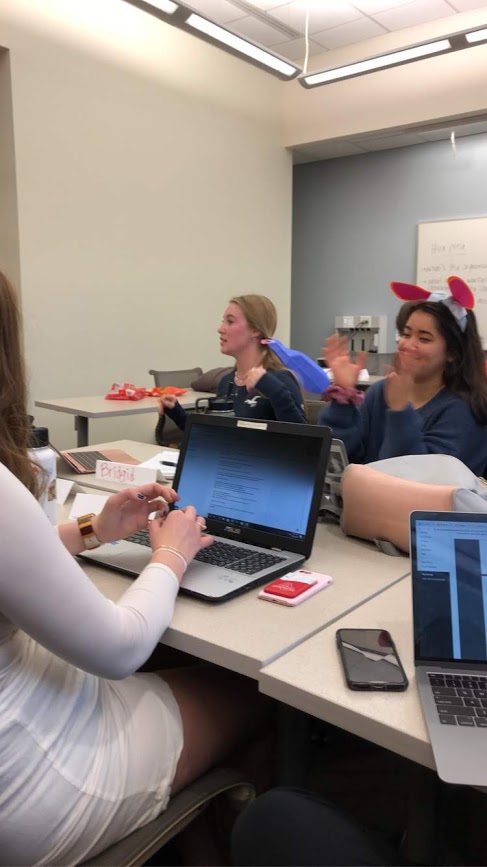
Bias Game
We discussed many issues concerning media in class today. Among the plethora of causes and problems, I feel that the heart of the issue stems from the human tendency for bias. In media, bias is produced at two levels:
Level one: interpreting what an article/resource actually means
Level two: intentional framing of an issue to mold it to an audience
To demonstrate, let's play a game! Below are pictures from class with three possible captions. Your job is to first discern which caption is accurate. Then, you have to choose the caption which you believe will attract the most views on social media.
1.
 a. Rebecca and Emily pose for the profile picture for their joint Instagram
b. AU softball star meets with student government to discuss new female athlete initiatives.
c. Rebecca and Emily, dressed as a frat-boy, pose for a picture
2.
 a. Annie hides Holt's breakfast in her bag while Holt is distracted
b. Holt prepares for putting on the kid's Winnie the Pooh performance for the kindergartners.
c.Holt helps Xandra remove a staple from a bandanna while Annie removes crafts from her bag.
3.
 a. Brigid makes an amazing comment concerning Harry Potter which is appreciated by Siena.
b. Siena applauds as her best friend is chosen to go up to help the presenter demonstrate his new technique!
c.Brigid stumps PTJ and, after busting out a sick dance move, causes rounds of applause to breakout out among her fellow students such as Siena is demonstrating here.
4.
 a. Annie and Jacob compete to see who can put on their ears fastest.
b. Annie and Jacob adjust their home-made character ears.
c. In the first annual Pinterest conference, participants have a class on kids animal crafts.
5.
 a. Noël demonstrates for Jacob what being a polite person looks like after noting his previous lack of gentleman behavior.
b. Brigid, Jacob, and Noël enter the classroom at the beginning of class.
c. Noël tries to usher Jacob and Bridgid out after Bridgid makes a controversial statement.
6.
 a. Danielle poses as a Tennis player.
b. Danielle gets ready to lead the first Tennis club meeting at AU!
c. Danielle puts comes to class after a hard won morning tennis match.
7.
 a. Maddy and Shruthi meet before leaving for the recreation of the Salem witch trials.
b. Maddy and Shruthi pose before doing a presentation on the Yin and Yang symbol.
c. Shruthi and Maddy pose for a photo with their costumes.
8.
 a. Group discussions about media portrayal of 'foreign brides'
b. A multi-generational group, including a grandma in pearl earrings and performer for the Day of the Dead celebration, meet together to learn about new community initiatives.
c. The Spanish class has a lesson on interrogatives.
9.
 a. Noël prepares to catch a fastball from PTJ.
b. Noël makes another insightful point in class.
c. Noël gets startled by the sudden scurry of a mouse across the room.
10.
 a. Yuzuka smiles after being complimented by the love of her life.
b. Yuzuka prepares for rehearsal as the lead angel in a performance of a Broadway Christmas play.
c. Yuzuka poses for a photo in her angel costume.
Level one: interpreting what an article/resource actually means
Level two: intentional framing of an issue to mold it to an audience
To demonstrate, let's play a game! Below are pictures from class with three possible captions. Your job is to first discern which caption is accurate. Then, you have to choose the caption which you believe will attract the most views on social media.
1.

b. AU softball star meets with student government to discuss new female athlete initiatives.
c. Rebecca and Emily, dressed as a frat-boy, pose for a picture
2.

b. Holt prepares for putting on the kid's Winnie the Pooh performance for the kindergartners.
c.Holt helps Xandra remove a staple from a bandanna while Annie removes crafts from her bag.
3.
b. Siena applauds as her best friend is chosen to go up to help the presenter demonstrate his new technique!
c.Brigid stumps PTJ and, after busting out a sick dance move, causes rounds of applause to breakout out among her fellow students such as Siena is demonstrating here.
4.

b. Annie and Jacob adjust their home-made character ears.
c. In the first annual Pinterest conference, participants have a class on kids animal crafts.
5.

b. Brigid, Jacob, and Noël enter the classroom at the beginning of class.
c. Noël tries to usher Jacob and Bridgid out after Bridgid makes a controversial statement.
6.

b. Danielle gets ready to lead the first Tennis club meeting at AU!
c. Danielle puts comes to class after a hard won morning tennis match.
7.

b. Maddy and Shruthi pose before doing a presentation on the Yin and Yang symbol.
c. Shruthi and Maddy pose for a photo with their costumes.
8.

b. A multi-generational group, including a grandma in pearl earrings and performer for the Day of the Dead celebration, meet together to learn about new community initiatives.
c. The Spanish class has a lesson on interrogatives.
9.

b. Noël makes another insightful point in class.
c. Noël gets startled by the sudden scurry of a mouse across the room.
10.

b. Yuzuka prepares for rehearsal as the lead angel in a performance of a Broadway Christmas play.
c. Yuzuka poses for a photo in her angel costume.
Tuesday, October 29, 2019
National Security Quiz
Discovering nation security quiz
On a national scale how concerned/worried are you about:
1- not at all worried or concerned 3-somewhat worried/concerned 5-very worried/concerned
Terrorism (home grown or abroad)
1 2 3 4 5
Cyber Security
1 2 3 4 5
Water and/or Food Security
1 2 3 4 5
Conflict with Russia
1 2 3 4 5
Conflict with China
1 2 3 4 5
Alien invasion from outer-space
1 2 3 4 5
Immigration issues
1 2 3 4 5
Religious influence in our government
1 2 3 4 5
Global warming
1 2 3 4 5
Disease outbreak
1 2 3 4 5
Ebola
1 2 3 4 5
Any other points of concern or worry?
Congratulations! You just helped define issues of national security based on your own perceptions! Now, have a friend take the quiz and see if you get the same answers.
Different results of the quiz are normal. What is considered an issue of national security is just as malleable to a person's personal lens as what route is most desirable to take home. Although there is basis for reasoning, in the end the 'security' is a matter of opinion with plenty of alternatives. In essence, I believe this to be a good thing. There are so many factors nowadays that can effect citizen's livelihood that if security was put in a more restrictive box, it is nearly ensured that a factor will be overlooked. Having a direction for policy initiatives decided by the current perceptions around national security, as Wolfers puts it, is important for the order of the government. When has a project or organization ever been successful without some basis of a plan, purpose, and direction? Whether you agree with the security issues and solutions outlined in this week's readings, having that direction and breadth focus is far better than none at all, or a much more restricted one that ignores potentially important issues.
On a national scale how concerned/worried are you about:
1- not at all worried or concerned 3-somewhat worried/concerned 5-very worried/concerned
Terrorism (home grown or abroad)
1 2 3 4 5
Cyber Security
1 2 3 4 5
Water and/or Food Security
1 2 3 4 5
Conflict with Russia
1 2 3 4 5
Conflict with China
1 2 3 4 5
Alien invasion from outer-space
1 2 3 4 5
Immigration issues
1 2 3 4 5
Religious influence in our government
1 2 3 4 5
Global warming
1 2 3 4 5
Disease outbreak
1 2 3 4 5
Ebola
1 2 3 4 5
Any other points of concern or worry?
Congratulations! You just helped define issues of national security based on your own perceptions! Now, have a friend take the quiz and see if you get the same answers.
Different results of the quiz are normal. What is considered an issue of national security is just as malleable to a person's personal lens as what route is most desirable to take home. Although there is basis for reasoning, in the end the 'security' is a matter of opinion with plenty of alternatives. In essence, I believe this to be a good thing. There are so many factors nowadays that can effect citizen's livelihood that if security was put in a more restrictive box, it is nearly ensured that a factor will be overlooked. Having a direction for policy initiatives decided by the current perceptions around national security, as Wolfers puts it, is important for the order of the government. When has a project or organization ever been successful without some basis of a plan, purpose, and direction? Whether you agree with the security issues and solutions outlined in this week's readings, having that direction and breadth focus is far better than none at all, or a much more restricted one that ignores potentially important issues.
Subscribe to:
Posts (Atom)